Zygoma Implant for Patients Who Have Experienced Previous Implant Failure
Did your implant treatment, which you started with hope in the best clinics of Istanbul, last for months, and perhaps for which you made a large payment, end in failure? We can imagine the disappointment you feel when you feel your implant is loose, the helplessness when you hear the phrase, “My body rejected the implant.”
Many patients, after the failure of the first attempt, think, “My jawbone is not suitable, I am now condemned to dentures for the rest of my life.” However, there is no “helplessness” in modern surgery. If your standard implants did not take due to bone loss or infection (Peri-implantitis), the solution is not to place the same implant again in the same place; it is to completely change the strategy. This is where the savior of dentistry, Zygoma Implants, comes into play.
Why Did Your First Implant Fail?
To understand the solution, we must first analyze the problem. 90% of implant failures are due to “Integration (Fusion)” problems.
- Insufficient Bone Volume: If there is not enough bone to hold the implant, the implant will loosen in a short time.
- Peri-implantitis: This is the development of gum disease around the implant and the erosion of bone.
- Incorrect Planning: Incorrect calculation of chewing pressure.
When an implant fails, it leaves a large bone loss (crater) where it was removed. Placing a standard implant in this area again is like building a building on soft ground; it will fail again.
Zygoma Implant: Why Not a “Second Chance,” but “The Strongest Chance”?
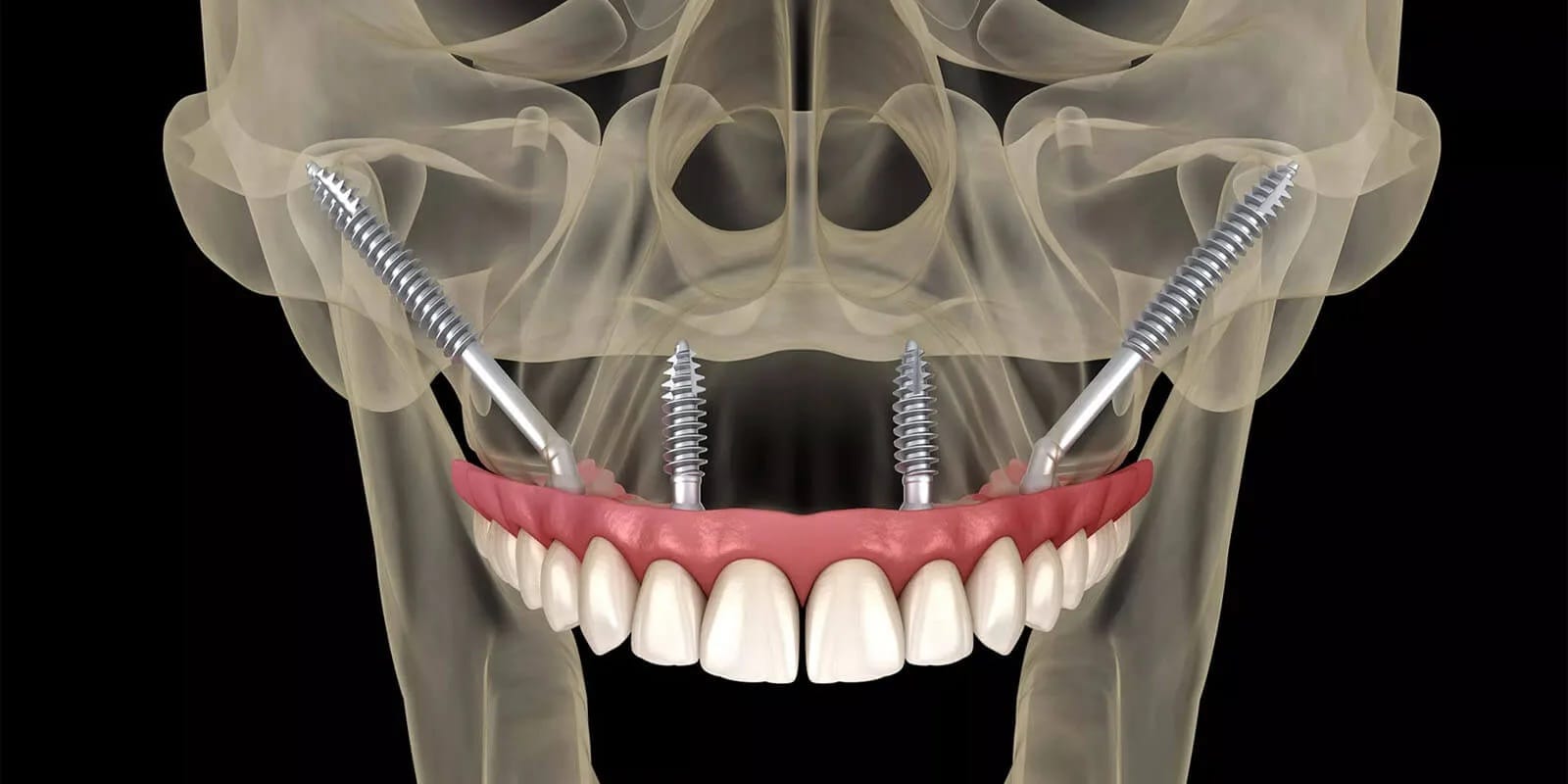
In a failed upper jaw case, the bone inside the mouth (alveolar bone) is no longer usable. The difference with zygoma implants is this: These implants attach not to the resorbed oral bone, but to the strongest bone in our face, the “zygoma” (cheekbone).
🦴 The Difference in Bone Quality
The jawbone (alveolar bone) has a “spongy” structure and resorbs very quickly with infection and edentulism. However, the cheekbone (zygomatic bone) is “cortical,” meaning it is as hard and dense as marble. Even if you age or lose teeth, your cheekbone will not resorb. When a zygoma implant is placed here, it provides ten times stronger retention than a standard implant. Therefore, the chance of a zygoma implant failing is very low.
Advantages for Patients with Previous Failures
If you are afraid that “my body will not accept the implant,” Zygoma offers you:
- 1. No Need for Bone Grafting (Powder)
The bone powder used in your first implant may have dissolved. With a zygoma implant, there is no need to add bone because the cheekbone is already there and ready. The waiting period is eliminated. - 2. Infection-Free Area
Bacteria and gum diseases in the mouth affect the jawbone, but the cheekbone is far from the oral environment. Therefore, the risk of “Peri-implantitis” (inflammation around the implant) is almost nonexistent with Zygoma.
3. Immediate Fixed Teeth (Psychological Repair)
A patient who has experienced failure cannot tolerate being toothless for months. The retention of zygoma implants is so high that your fixed teeth are fitted 3 days after the operation.
Zygoma Treatment in Istanbul: Requires Expertise
You might ask, “If it’s so good, why wasn’t it done the first time?” Because zygoma implant is not a standard dental procedure. It is a very advanced technique requiring expertise in Maxillofacial Surgery.
Istanbul is one of the world’s leading centers in this field. It is performed under general anesthesia by surgeons specializing in this area only in fully equipped clinics and private hospitals along the Nişantaşı, Levent, and Bağdat Caddesi lines. Any doctor can perform a standard implant, but only “master surgeons” can perform zygoma implants.
📍 Surgical Superiority of Istanbul
Many patients who experience implant failure in Europe or America come to Istanbul for “revision” (corrective) surgery. This is because surgeons in Istanbul have very high case experience, and risks are minimized with 3D CT-assisted digital planning.
Big Comparison: Standard Implant Replacement vs. Zygoma
Differences between trying the same method again in a failed case and proceeding to Zygoma:
| Feature | Repeating Standard Implant (with Bone Powder) | Zygoma Implant Treatment |
|---|---|---|
| Chance of Success | Risky (The foundation is already weak, it may not hold) | Very High (98%) – Provided |
Duration12-18 Months (Bone formation is expected)3-5 Days (Tooth is attached immediately)Number of SurgeriesMultiple Surgeries (Grafting + Implant)Single SurgeryRisk of InfectionHigh (Exposed to oral bacteria)Very Low (Sterile area)CostUncertain (Additional materials may be required)Fixed and Planned
How Does the Process Work?
- Detailed Analysis: Existing damage is detected with 3D Dental Tomography and the cheekbone is measured.
- General Anesthesia: The operation is performed in a hospital setting while the patient is fully asleep. The patient feels nothing.
- Zygoma Placement: 2 or 4 long implants are placed in the cheekbone.
- Fixed Teeth: After the operation, impressions are taken and temporary fixed prostheses are screwed in within 72 hours. The patient is not toothless when looking in the mirror.
Conclusion: No Despair, There is a Solution
Experiencing implant failure is traumatic, but it’s not the end of the road. On the contrary, with Zygoma implants, you can have teeth with a much stronger foundation than before. Even if your jawbone has resorbed, your cheekbones are there, ready to support you.
With our expert surgeons in Istanbul who have turned cases deemed “impossible” into routine, you can turn your story of failure into a success story. You no longer need to be afraid; because this time your implant is entrusted not to a decayed foundation, but to the strongest bone in your body.